
No obligation to purchase.
Flood Insurance Basics
What Does Flood Insurance Cover?
By Iron Axis Insurance Agency Team
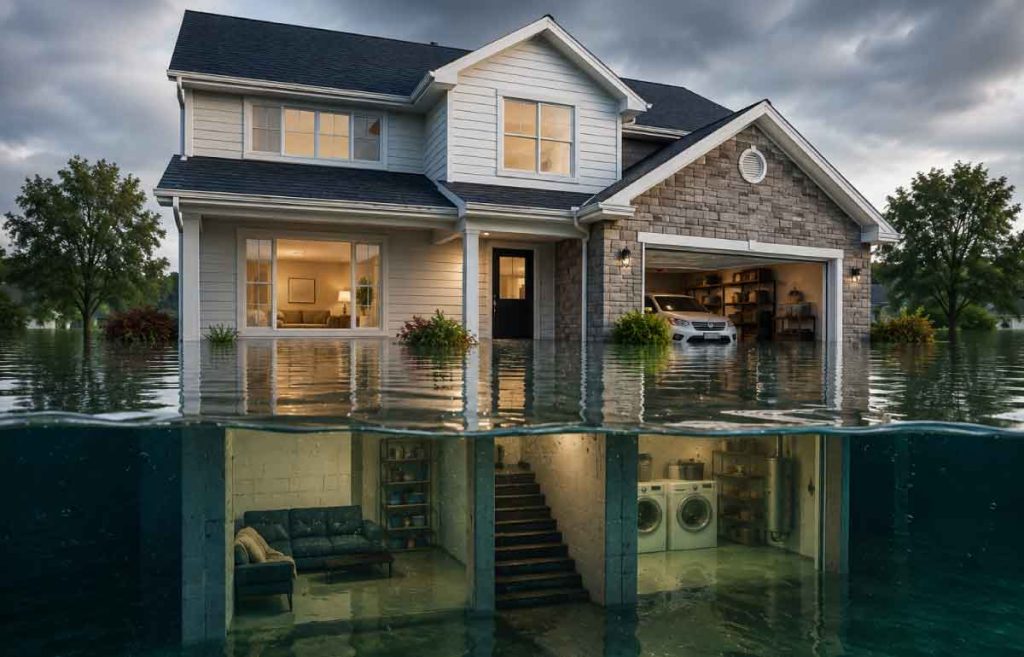
Flood insurance coverage is a policy that pays for physical damage to a home or business after a flood, something a standard homeowners or commercial property policy does not cover. Iron Axis Insurance Agency places both National Flood Insurance Program policies and private flood policies from carriers like Neptune Flood and Aon Edge, so property owners can compare options side by side instead of settling for whatever a single carrier offers.
What Flood Insurance Actually Covers
A flood insurance policy is built around two separate coverages, and a property owner can buy one or both. Building property coverage pays to repair or rebuild the structure itself. Personal property coverage, sometimes called contents coverage, pays to replace belongings inside the structure.
Building property coverage typically includes
- The foundation and its footings, walls, and support structure
- Electrical and plumbing systems
- Furnaces, water heaters, and central air conditioning equipment
- Built in appliances such as a stove or refrigerator
- Permanently installed carpeting and cabinetry
Personal property coverage typically includes
- Clothing, furniture, and electronics
- Portable appliances such as a microwave or window air conditioner
- Curtains and area rugs
- Certain valuable items, up to policy sublimits
How Much Coverage You Can Buy
Coverage limits depend on whether the policy is written through the NFIP or through a private carrier.
NFIP residential policies max out at $250,000 for the building and $100,000 for contents. Non residential NFIP policies, which include most commercial buildings, max out at $500,000 for the building and $500,000 for contents. These limits are set by federal law and cannot be raised, regardless of what a property is actually worth.
Private flood carriers are not bound by those caps. Depending on the carrier and the property, private policies can offer building limits well above the NFIP maximum, along with features such as replacement cost coverage on contents and additional living expense coverage while a home is being repaired.
What Flood Insurance Does Not Cover
A flood policy pays for direct physical loss caused by a flood, defined generally as surface water covering normally dry land, usually affecting two or more properties or at least an acre. It is not a catch all water damage policy. Common exclusions include
- Water damage from a burst pipe or plumbing failure inside the home, which is a homeowners insurance claim, not a flood claim
- Sewer or drain backup that is not caused by flooding, unless a separate endorsement is added
- Mold or mildew that could have been prevented with reasonable care after a loss
- Damage to a detached structure, unless a separate policy or endorsement is written for it
- Living expenses while a home is uninhabitable, on a standard NFIP policy
- Currency, precious metals, and most vehicles
Actual Cash Value Versus Replacement Cost
Under a standard NFIP policy, personal property is reimbursed at actual cash value, meaning the item’s value at the time of the loss after depreciation, not what it would cost to buy new. Building coverage on a primary residence can qualify for replacement cost coverage if the home is insured to at least 80 percent of its replacement value, but contents remain actual cash value under NFIP rules.
Private flood policies vary by carrier. Some offer full replacement cost on both the building and contents, which can matter significantly for a total loss claim.
The Waiting Period Before Coverage Begins
A new NFIP policy generally has a 30 day waiting period before coverage takes effect, so a policy bought today will not pay for a flood that happens next week. There are exceptions. The waiting period does not apply when flood insurance is required as part of a mortgage closing, an increase in a loan amount, or a refinance. It also does not apply within 13 months of a flood map revision that newly places a property in a high risk zone, and there is a shortened window tied to nearby wildfire activity.
Private carriers set their own waiting periods, which are often shorter than 30 days and, in some real estate closing situations, can be waived entirely.
Do You Need Flood Insurance Outside a High Risk Zone
A federally backed mortgage on a home in a FEMA designated Special Flood Hazard Area generally requires flood insurance as a condition of the loan. Outside that zone, a lender usually will not require it. Flood risk does not stop at the zone line, however. According to FEMA’s FloodSmart program, close to a third of NFIP claims filed between 2014 and 2024 came from properties outside the current high risk zones. Moderate and low risk zone policies are also typically less expensive, which makes coverage worth pricing out even when it is optional.
National Flood Insurance Program (NFIP) vs. Private Flood Insurance
A side by side look at how the two main flood coverage paths compare.
| Feature | NFIP | Private Flood Insurance |
|---|---|---|
| Residential building limit | $250,000 maximum | Often available above $250,000, varies by carrier |
| Residential contents limit | $100,000 maximum | Often available above $100,000, varies by carrier |
| Contents valuation | Actual cash value | Replacement cost available with some carriers |
| Waiting period | 30 days, with limited exceptions | Often shorter, varies by carrier and situation |
| Additional living expenses | Not included | Available with some carriers |
| Where it is available | Nationwide, including most high risk zones | Expanding, but not every carrier writes in every zone |
| Satisfies mortgage requirement | Yes | Yes, when the policy meets the lender's equivalence standard |
Not sure how much flood coverage you need?
Iron Axis compares NFIP and private flood quotes side by side so you can see your real options in minutes.
- Get a Free Flood Quote
Frequently Asked Questions
Is flood insurance required by law?
It is required as a condition of a federally backed mortgage on a property located in a FEMA Special Flood Hazard Area. It is not required by law simply for owning property in that zone if there is no mortgage tied to it, though the risk is the same either way.
Does homeowners insurance cover flooding?
No. A standard homeowners or commercial property policy excludes flood damage. Flood coverage has to be purchased separately, either through the NFIP or a private carrier.
How long until a new flood policy takes effect?
NFIP policies generally have a 30 day waiting period, with exceptions for certain mortgage transactions and recent flood map changes. Private carrier waiting periods vary and are often shorter.
Can I buy more coverage than the NFIP maximum?
Yes. Many property owners layer an NFIP policy with a private excess flood policy, or replace the NFIP policy entirely with a private policy that offers higher limits.
Are contents automatically covered under a flood policy?
No. Building coverage and contents coverage are purchased separately. A property owner who wants belongings covered needs to select contents coverage specifically.
Will private flood insurance satisfy my lender?
Generally yes, as long as the private policy meets the federal standard of providing coverage at least as broad as an NFIP policy. It is worth confirming acceptance with the lender before relying on a private policy to satisfy a mortgage requirement.
Comparing Your Flood Coverage Options
NFIP coverage gives a property owner a standardized, nationwide baseline, capped at $250,000 for the building and $100,000 for contents on a residential policy. Private flood insurance can raise those limits, add replacement cost coverage, and sometimes shorten the waiting period, but availability and pricing vary by carrier and location. The right choice usually comes down to the property’s value, its location, and what a lender requires, which is why it helps to price both paths before deciding.
Ready to see your flood insurance options?
Iron Axis Insurance Agency compares NFIP and private flood carriers so you can choose coverage that actually fits your property.
- Get a Free Flood Quote