
No obligation to purchase.
SPECIALTY FLOOD INSURANCE
Flood Zone X Insurance: Is It Required, What Does It Cost & Should You Buy It?
By Iron Axis Insurance Agency Team
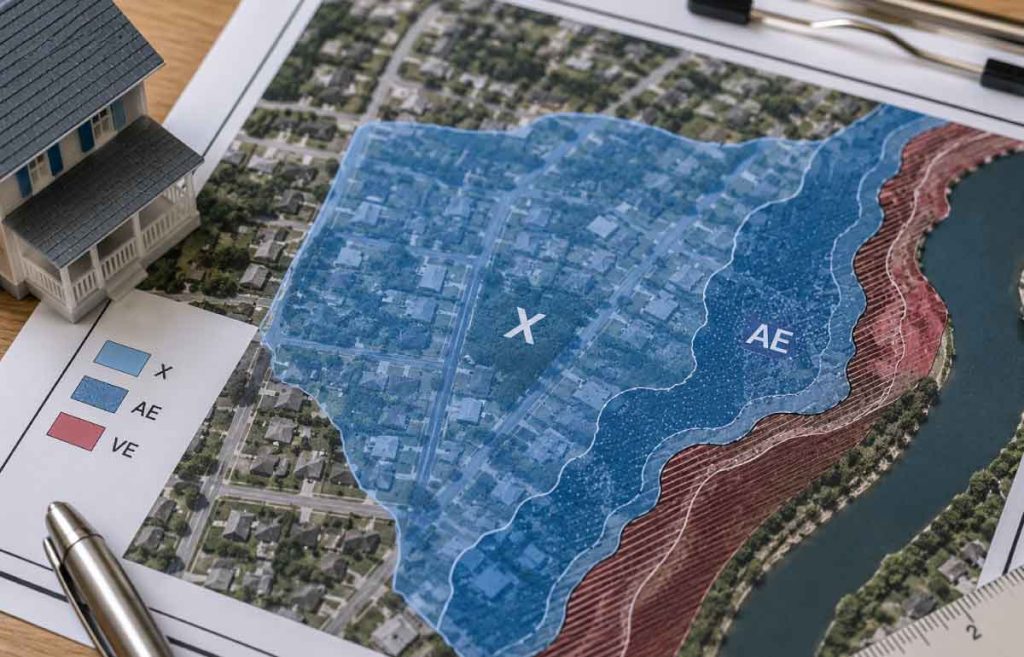
If your property is in FEMA Flood Zone X, flood insurance is generally not federally required based solely on the Zone X designation because Zone X is outside the Special Flood Hazard Area (SFHA).
But that does not mean your property has no flood risk.
FEMA uses Zone X for areas with moderate or minimal mapped flood hazard. There are also important differences between shaded Zone X and unshaded Zone X.
FloodSmart reports that from 2014 through 2024, 29% of NFIP flood insurance claims came from areas outside current high risk flood areas.
So the more useful question isn’t simply, “Am I required to have flood insurance in Zone X?”
It’s also: what is my actual flood risk, what would coverage cost, and could I afford a flood loss without insurance?
What Is an X Flood Zone?
Flood Zone X is a FEMA flood zone designation for areas outside the Special Flood Hazard Area. FEMA separates Zone X into two general categories.
Shaded Zone X: Moderate Flood Hazard
Shaded Zone X generally identifies areas of moderate flood hazard. FEMA describes these areas as lying between the limits of the 1% annual chance flood and the 0.2% annual chance flood.
The 0.2% annual chance event is sometimes called the “500 year flood,” although that terminology can be misleading. It does not mean flooding happens only once every 500 years. A 0.2% annual chance means that level of flooding has a 0.2% probability of being equaled or exceeded in any given year.
FEMA also uses shaded Zone X in certain areas involving shallow flooding or levee related conditions.
Unshaded Zone X: Minimal Flood Hazard
Unshaded Zone X generally represents an area of minimal mapped flood hazard outside the Special Flood Hazard Area and above the elevation associated with the 0.2% annual chance flood.
Again, minimal risk does not mean zero risk. Flood maps cannot predict every possible flood. Local drainage, extreme rainfall, changing development, wildfire, infrastructure problems, and other conditions can contribute to flooding even outside FEMA’s high risk zones.
Shaded Zone X vs. Unshaded Zone X
Understanding which type of Zone X appears on your FEMA map is important.
| Zone X Type | General FEMA Classification |
Federal Mandatory Purchase Based on Zone |
|---|---|---|
| Shaded Zone X |
Moderate flood hazard |
Generally no |
| Unshaded Zone X |
Minimal flood hazard |
Generally no |
Both are outside the Special Flood Hazard Area. The difference is the level of mapped flood hazard. A property in shaded Zone X generally has greater mapped flood exposure than a property in unshaded Zone X. However, the flood zone designation should be treated as one piece of the property’s overall flood risk picture.
Does Flood Zone X Require Flood Insurance?
Generally, federal mandatory purchase requirements do not apply simply because a property is located in Zone X.
Federal flood insurance purchase requirements are primarily associated with buildings located in a Special Flood Hazard Area that secure certain federally regulated, insured, or backed loans. FEMA identifies high risk A and V zones as Special Flood Hazard Areas. Zone X is outside the SFHA.
Therefore, if your lender tells you that your property is in Zone X, the FEMA designation itself generally does not trigger the federal mandatory purchase requirement.
There are, however, important exceptions to the practical answer.
Can a Lender Require Flood Insurance in Zone X?
Yes. A lender can have flood insurance requirements that go beyond the federal minimum. FloodSmart specifically notes that some banks require flood insurance even when a property isn’t located in a high risk area.
So these are two different questions. Does federal law require flood insurance because my property is in Zone X? Generally, no. Can my lender still require flood insurance? Potentially, yes.
If your lender requires coverage, ask what amount and type of flood insurance will satisfy its requirements before purchasing or changing a policy.
Do You Need Flood Insurance in Zone X?
You may not be required to purchase it, but that does not necessarily mean you don’t need it. Flood insurance becomes a personal risk management decision when it isn’t lender required.
One useful way to approach the decision is to ask:
- Could water reach my property during unusually heavy rainfall?
- Is the home near a river, creek, drainage channel, levee, or other flood source?
- Has the neighborhood experienced flooding?
- Is the property downhill from recently burned land?
- Could local drainage or surface water runoff affect the property?
- How much would I have to pay myself if the building flooded?
- What would flood insurance actually cost for this property?
That last question can be particularly useful. Before deciding that flood insurance isn’t worthwhile, find out what it costs.
How Common Are Flood Claims Outside High Risk Zones?
They are not rare. FloodSmart reports that 29% of NFIP flood insurance claims from 2014 through 2024 came from areas outside current high risk flood areas.
That does not mean every Zone X property has the same risk. It demonstrates something more important: being outside an A or V high risk flood zone does not eliminate the possibility of an insured flood loss.
Flood maps identify levels of flood hazard. They are not guarantees that a property will or will not flood.
Does Homeowners Insurance Cover Flooding in Zone X?
Most homeowners insurance does not cover flood damage. This remains true even if the home is located in Zone X.
A homeowners policy and a flood insurance policy protect against different risks. A homeowner who decides not to purchase flood insurance should therefore understand that being in a lower risk FEMA zone does not normally cause a standard homeowners policy to begin covering flood losses.
If a covered flood occurs without flood insurance, the homeowner may be responsible for the resulting flood damage.
How Much Does Flood Insurance Cost in Zone X?
There is no universal Zone X flood insurance rate. Two homes located in Zone X can have different NFIP premiums.
Under FEMA’s current Risk Rating 2.0 methodology, NFIP pricing incorporates individual property and flood risk characteristics rather than simply assigning a price from the flood zone designation. Factors can include characteristics related to:
- Distance from flood sources
- Type of flood exposure
- Elevation
- First floor height
- Foundation
- Building characteristics
- Replacement cost
- Coverage selected
- Deductible selected
This is why searching for a single “Zone X flood insurance rate” can be misleading. Your actual premium depends on the property.
Is Flood Insurance Cheaper in Zone X?
A lower risk property may generally cost less to insure than a property presenting substantially greater flood risk. However, Zone X does not automatically equal a specific low premium. FEMA’s current pricing methodology evaluates more than the flood zone letter.
Private flood insurance companies also use their own underwriting and pricing systems. That means a Zone X property could receive an NFIP quote, one or more private flood insurance quotes, different coverage limits, different deductibles, and different premiums.
The best way to determine whether Zone X flood insurance is inexpensive for your property is to obtain actual quotes.
Does FEMA Still Use Flood Zones to Calculate NFIP Rates?
Flood zones remain important, but FEMA moved away from using the flood zone designation as the primary basis for NFIP pricing with Risk Rating 2.0. FEMA’s current methodology incorporates individual property characteristics and more detailed flood risk information.
Flood zones continue to be important for purposes including:
- Flood risk communication
- Floodplain management
- Building requirements
- Determining whether federal mandatory purchase requirements apply
This distinction matters. Flood zone helps answer whether coverage may be federally required. Property specific risk information helps determine what NFIP coverage costs.
Can You Buy NFIP Flood Insurance in Zone X?
Yes, assuming the property is otherwise eligible and the community participates in the National Flood Insurance Program. You do not have to live in a high risk FEMA flood zone to purchase NFIP coverage.
FloodSmart says NFIP insurance is available to eligible property owners in communities that participate in the program’s floodplain management requirements. Most U.S. communities participate.
This makes NFIP coverage an option worth investigating even when a Zone X homeowner is purchasing flood insurance voluntarily.
Can You Buy Private Flood Insurance in Zone X?
Potentially.
Private flood insurers establish their own underwriting guidelines, eligibility requirements, coverage limits, and pricing. A Zone X property may be attractive to some private insurers because of its flood risk characteristics, but coverage should never be assumed to be available or inexpensive simply because the FEMA designation is X.
Depending on the property and insurance market, you may be able to compare NFIP flood insurance with private flood insurance. Compare more than the premium. Review:
- Building coverage
- Contents coverage
- Deductibles
- Coverage terms
- Exclusions
- Effective date
- Additional coverage features
- Lender requirements, when applicable
NFIP vs. Private Flood Insurance in Zone X
Neither option is automatically better.
The NFIP provides standardized federal flood coverage subject to NFIP rules and limits. Private insurers develop their own policies. Some private policies may offer:
- Different coverage limits
- Higher residential building limits
- Different deductible options
- Additional coverage features
- Different pricing
Private coverage can also have different exclusions, underwriting requirements, and policy conditions. The appropriate comparison is therefore between the actual policies available for your property.
What Does Zone X Flood Insurance Cover?
Coverage depends on the policy purchased. Under an NFIP policy, eligible residential property owners can purchase separate coverage for the building and its contents.
For an eligible one to four family residential property, NFIP limits can provide up to $250,000 in building coverage and $100,000 in contents coverage. Building and contents coverage are separate.
Private flood policy limits and coverage features vary by insurer.
Should You Buy Flood Insurance in Zone X?
There isn’t one correct answer for every Zone X property. Instead, evaluate three things.
Your actual flood exposure. Look beyond the FEMA zone letter. Consider local drainage, nearby water, elevation, wildfire history, levees, and previous flooding.
Your financial exposure. Ask what would happen financially if floodwater entered the property. Could you comfortably pay for significant repairs and replacement of damaged belongings yourself?
The cost of transferring that risk. Get a flood insurance quote. A homeowner might decide against coverage without knowing whether insurance would cost hundreds or thousands of dollars for that specific property. Knowing the actual premium makes the decision much more informed.
When Zone X Flood Insurance May Be Worth Considering
Flood insurance may deserve additional consideration when:
- The property is in shaded Zone X
- A river, creek, or drainage channel is nearby
- The home is near a levee
- The neighborhood has flooded previously
- Heavy rainfall produces significant surface runoff
- The property is downhill from a wildfire burn area
- Local drainage has been problematic
- The homeowner could not comfortably absorb a major flood loss
- The quoted premium makes transferring the risk financially reasonable
These aren’t automatic indications that you need insurance. They are reasons to investigate the risk rather than relying exclusively on the Zone X designation.
Zone X and Levees
Zone X deserves particular attention in areas protected by levees.
FEMA notes that some moderate risk areas may have reduced flood exposure because of mitigation efforts such as levees. But reduced risk is not eliminated risk. A levee changes flood risk; it does not make flooding impossible.
Property owners in levee protected communities should therefore consider local flood control information in addition to the FEMA flood zone designation.
Zone X Flood Insurance in California
Zone X is especially relevant for FloodAxis’s California readers because many California communities have complex flood control systems, rivers, drainage networks, wildfire exposure, and levees.
California’s flood history also demonstrates why being outside a high risk zone should not automatically end the insurance discussion. FloodSmart reports that NFIP policyholders in California received more than $209 million in flood claim payments from 2013 through 2023. It also reports that nearly one third of NFIP claims in California come from outside high risk flood zones.
California homeowners in Zone X should therefore evaluate their individual property rather than assuming “Zone X” means “no flood risk.”
How Wildfires Can Affect a Zone X Property
Wildfire can change local flood conditions. After vegetation burns, rainfall can run off the landscape more rapidly rather than being absorbed into vegetation and soil.
FloodSmart says flood risk can remain significantly elevated following wildfire until vegetation is restored. That means a Zone X property near or downhill from a burn area may deserve a fresh flood risk assessment even if its FEMA zone has not changed.
The flood zone designation is not a real time guarantee of what will happen during the next storm.
How to Find Out if Your Property Is in Flood Zone X
FEMA’s Flood Map Service Center provides the official public source for Flood Insurance Rate Maps. Search for the property address and review the applicable map. Determine whether the property appears in:
- Shaded Zone X
- Unshaded Zone X
- An A zone
- A V zone
- Another FEMA designation
Local floodplain administrators can also provide useful information about local flood hazards and map changes.
Do not rely solely on a real estate listing or an old insurance document when you need a current flood zone determination.
What if You Think FEMA Put Your Property in the Wrong Flood Zone?
FEMA has formal map change processes. Depending on the circumstances, a property owner may be able to request a Letter of Map Amendment (LOMA) or another Letter of Map Change.
A map amendment is not simply a request to lower an insurance premium. Specific technical and elevation information may be required to demonstrate that FEMA’s mapped floodplain does not accurately apply to the building or property in the manner shown.
Property owners considering a map change should follow FEMA’s current procedures or consult an appropriate floodplain professional.
Ready to Compare California Flood Insurance Options?
Tell us about your property and we'll review available private flood insurance and NFIP options.
- GET MY PRIVATE FLOOD INSURANCE QUOTE →
Flood Zone X Insurance FAQ
What is an X flood zone?
Zone X is a FEMA designation for areas outside the Special Flood Hazard Area. Shaded Zone X generally represents moderate flood hazard, while unshaded Zone X generally represents minimal mapped flood hazard.
Does Flood Zone X require flood insurance?
Generally, the Zone X designation itself does not trigger federal mandatory purchase requirements because Zone X is outside the Special Flood Hazard Area.
Can my lender require flood insurance in Zone X?
Yes. A lender may establish flood insurance requirements beyond the federal minimum. FloodSmart specifically notes that some banks require coverage even outside high risk areas.
Do you need flood insurance in Zone X?
It may be worth considering even when it isn’t required. FEMA reports that 29% of NFIP claims from 2014 through 2024 occurred outside current high risk flood areas.
What is shaded Flood Zone X?
Shaded Zone X generally identifies areas of moderate flood hazard, including areas between the 1% annual chance and 0.2% annual chance flood boundaries and certain other moderate hazard situations.
What is unshaded Flood Zone X?
Unshaded Zone X generally represents areas of minimal mapped flood hazard outside the Special Flood Hazard Area and above the 0.2% annual chance flood elevation.
How much does flood insurance cost in Zone X?
There is no single Zone X rate. FEMA’s current NFIP pricing methodology evaluates individual property and flood risk characteristics. Private flood insurers use their own underwriting and pricing.
Is flood insurance cheap in Zone X?
It can be relatively affordable for some lower risk properties, but Zone X does not guarantee a particular premium. Obtain a property specific quote.
Can I buy flood insurance in Zone X if my lender doesn’t require it?
Yes. Eligible property owners in NFIP participating communities can voluntarily purchase NFIP coverage. Private flood insurance may also be available depending on underwriting.
Does homeowners insurance cover flooding in Zone X?
Most homeowners insurance policies do not cover flood damage. Being located in Zone X does not change that general exclusion.
Is Zone X safe from flooding?
No FEMA flood zone represents zero risk. Zone X represents moderate or minimal mapped flood hazard depending on whether the designation is shaded or unshaded.
Get a Flood Zone X Insurance Quote
If your property is in Flood Zone X, don’t make the insurance decision from the map designation alone. Find out what coverage actually costs.
FloodAxis can help property owners explore available NFIP and private flood insurance options and compare:
- Flood insurance premiums
- Building coverage
- Contents coverage
- Deductibles
- NFIP options
- Private flood insurance options
- Flood zone considerations
- Lender requirements
Request a flood insurance quote for your Zone X property to compare available coverage and cost.
FloodAxis is a flood insurance information and insurance services resource operated by Iron Axis Insurance Agency, LLC. Flood zone information is provided for educational purposes and should not be considered an official flood zone determination. Insurance coverage is subject to eligibility, underwriting, policy terms, exclusions, limits, deductibles, carrier availability, and applicable state licensing.
Ready for a Private Flood Insurance Quote?
Provide a few details about your California property to get started.
- GET MY PRIVATE FLOOD INSURANCE QUOTE →