
No obligation to purchase.
SPECIALTY FLOOD INSURANCE
Flood Zone AE Insurance: Requirements, Cost & Coverage
By Iron Axis Insurance Agency Team
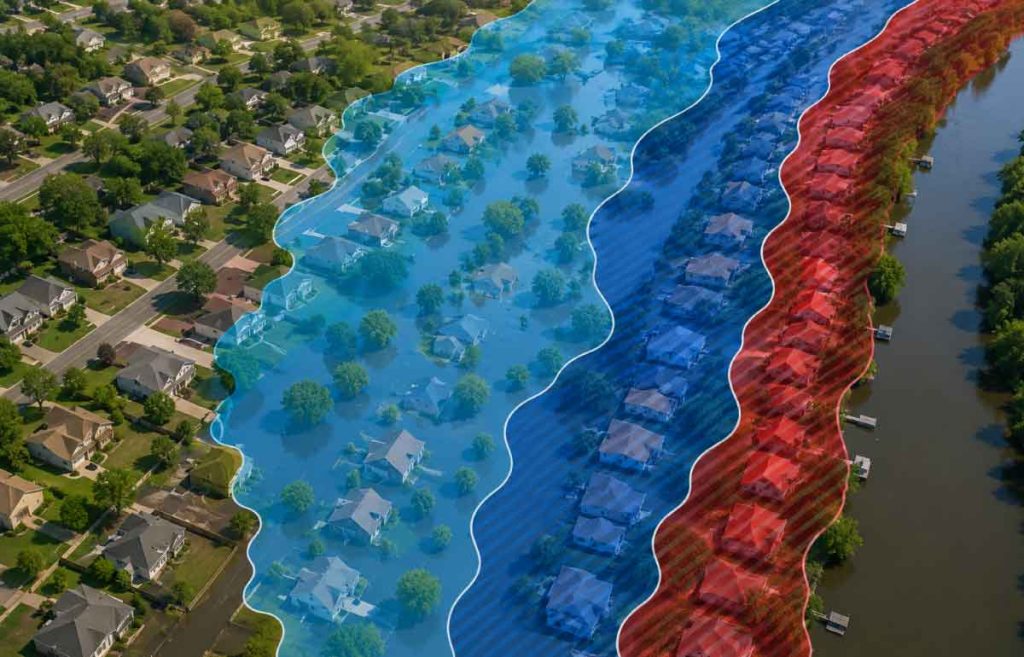
If your property is in FEMA Flood Zone AE, it is located in a high risk Special Flood Hazard Area associated with the 1% annual chance flood.
Flood insurance may be required when a Zone AE property has certain federally backed or regulated mortgage financing. Unlike Zone A, FEMA has performed a detailed flood analysis for Zone AE, and Base Flood Elevations (BFEs) are shown on the Flood Insurance Rate Map.
But being in Zone AE does not tell you exactly how much flood insurance will cost.
Under the NFIP’s current pricing methodology, premiums are property specific. FEMA considers where the property is built, how it is built, what it would cost to replace, and other risk characteristics. That means two homes in Flood Zone AE can have different flood insurance premiums.
What Is Flood Zone AE?
Flood Zone AE is one of FEMA’s high risk flood zones.
FEMA defines Zone AE as an area subject to inundation by the 1% annual chance flood event, with the flood risk determined using detailed methods. Base Flood Elevations are shown for these areas.
The 1% annual chance flood is sometimes referred to as the “100 year flood,” but that phrase can be misunderstood. It does not mean a flood will occur only once every 100 years. It means that level of flooding has a 1% chance of being equaled or exceeded in any given year.
Zone AE is also part of FEMA’s Special Flood Hazard Area, or SFHA. FEMA identifies Zones A, AE, AH, AO, AR, V, VE, and A99 among the zones included in the SFHA.
What Does the "AE" in Flood Zone AE Mean?
The important distinction is not simply the letters themselves but the level of flood analysis FEMA has completed.
With Zone A, FEMA identifies a high risk flood area, but detailed hydraulic analysis has generally not produced Base Flood Elevations on the map.
With Zone AE, FEMA has conducted a more detailed analysis and Base Flood Elevations are shown.
| Flood Zone |
Flood Risk | Base Flood Elevation |
|---|---|---|
| Zone X | Lower or moderate mapped risk | Generally not shown |
| Zone A | High risk | Generally not shown |
| Zone AE | High risk | Shown |
| Zone VE | High risk coastal area with additional wave hazard |
Shown |
The BFE becomes particularly important when evaluating building elevation, floodplain requirements, and mitigation.
What Is a Base Flood Elevation in Zone AE?
The Base Flood Elevation (BFE) is the elevation associated with the base flood, meaning the flood having a 1% chance of being equaled or exceeded in a given year.
FEMA’s detailed study of a Zone AE area establishes BFEs, which are displayed on the applicable Flood Insurance Rate Map.
For a property owner, the relationship between the building and the BFE can provide important information about flood exposure. For example, a home’s first floor positioned substantially above the BFE presents a different flood risk profile from a building positioned lower relative to that elevation.
This information can also matter when evaluating construction requirements and potential flood mitigation.
Does Flood Zone AE Require Flood Insurance?
Flood insurance is generally mandatory for certain mortgaged properties in Zone AE because Zone AE is a Special Flood Hazard Area.
FloodSmart states that homeowners and businesses in high risk A zones with federally backed mortgages must purchase flood insurance.
The important distinction is between the property’s flood zone designation and the property’s financing. A Zone AE designation establishes that the property is in an SFHA. Whether federal law requires a particular owner to maintain flood insurance depends on the applicable loan and federal requirements.
What If You Don’t Have a Mortgage?
The federal mortgage related mandatory purchase rule is not the same thing as a general law requiring every property owner in Zone AE to buy flood insurance.
For example, a property owned outright does not have a mortgage lender imposing a mortgage related flood insurance requirement. That doesn’t change the underlying flood hazard. A Zone AE property remains within FEMA’s high risk Special Flood Hazard Area regardless of whether the owner has a mortgage.
Can Your Mortgage Company Require Flood Insurance in Zone AE?
Yes.
For properties subject to federal mandatory purchase requirements, the lender must ensure that required flood insurance is maintained. Your lender may specify how much coverage is necessary to satisfy its requirements.
If you are buying a Zone AE property, refinancing one, or changing flood policies, determine the lender’s insurance requirements before changing coverage. Do not cancel existing flood insurance until replacement coverage and lender requirements have been addressed.
How Much Is Flood Insurance in Zone AE?
There is no single Zone AE flood insurance rate. This is one of the most important points for property owners searching for Zone AE insurance costs.
Under FEMA’s current NFIP pricing methodology, the flood zone designation alone does not determine the premium. FloodSmart says three broad considerations determine NFIP rates: where the property is built, how the property is built, and what it would cost to replace the property.
FEMA’s Risk Rating 2.0 methodology uses additional property specific risk information, including factors such as distance from a flooding source and replacement cost. So two Zone AE homes, even homes relatively close to each other, can have different premiums.
What Determines Flood Zone AE Insurance Rates?
Several characteristics can influence what an NFIP policy costs.
Location
The location of the property relative to potential flooding matters. FEMA’s current methodology uses geospatial and catastrophe modeling information to evaluate flood risk more precisely than simply assigning a rate based on a flood zone letter.
Distance From a Flood Source
Distance from rivers, streams, and other flood sources can influence the property’s risk. Two properties within the same Zone AE area may therefore have different characteristics.
Building Characteristics
How the home is constructed also matters. FloodSmart describes NFIP pricing as depending partly on how the property is built.
Replacement Cost
FEMA also incorporates the cost to rebuild the property into its current pricing methodology. Replacement cost should not be confused with real estate market value. The sale price of a property includes factors such as land and location. Replacement cost relates to rebuilding the insured structure.
Coverage Amount
How much insurance you purchase affects the policy. For an eligible one to four family residential property, current NFIP maximum limits are:
| Coverage | NFIP Maximum |
|---|---|
| Residential building | $250,000 |
| Residential contents | $100,000 |
Deductible
Building and contents coverage are generally purchased separately and can have separate deductibles. The deductible selected can affect premium and determines how much financial responsibility the policyholder retains after a covered loss.
Does the Base Flood Elevation Affect Zone AE Insurance Cost?
Elevation related information can be relevant to NFIP pricing, but you should not try to calculate a current premium simply by comparing the home to the BFE.
Risk Rating 2.0 moved NFIP pricing away from relying primarily on a building’s elevation and whether it was inside or outside a high risk flood zone. FEMA now uses multiple property specific risk variables.
Elevation information can still be useful. An Elevation Certificate documents important elevation characteristics of a building, and submitting one can potentially lower the price of flood insurance in appropriate circumstances.
Do You Need an Elevation Certificate in Flood Zone AE?
An Elevation Certificate can be valuable for a Zone AE property, but homeowners should not assume that every NFIP policy requires one simply because the property is in Zone AE.
Under Risk Rating 2.0, FEMA can rate many properties without requiring an Elevation Certificate. However, providing verified elevation information may be useful if it results in more favorable pricing.
Elevation Certificates can also be important for other floodplain management, construction, and regulatory purposes.
Zone AE vs. Zone X Flood Insurance
Zone AE and Zone X represent substantially different FEMA flood hazard classifications.
| Feature | Zone AE | Zone X |
|---|---|---|
| FEMA risk category | High risk | Moderate or lower mapped risk |
| Special Flood Hazard Area |
Yes | No |
| 1% annual chance flood area |
Yes | Generally outside |
| Base Flood Elevations |
Shown | Generally not shown |
| Federal mortgage insurance requirement |
Generally applies to covered loans |
Generally not triggered by zone alone |
| Flood insurance available |
Yes | Yes |
This is why the answer to “Do you need flood insurance in Zone AE?” is different from the answer for Zone X.
Related: Flood Zone X Insurance: Is It Required, What Does It Cost & Should You Buy It?
Does Homeowners Insurance Cover Flood Damage in Zone AE?
Most standard homeowners insurance does not cover flood damage. Living in a FEMA high risk flood zone does not cause a homeowners policy to automatically include flood coverage.
Flood insurance is typically purchased separately through the NFIP or, where available and appropriate, through a private flood insurance company. Most homeowners, renters, and business insurance policies do not cover flood damage.
What Does NFIP Flood Insurance Cover in Zone AE?
An NFIP policy can provide two primary types of protection.
Building Coverage
Building coverage can protect eligible parts of the insured structure, including items such as:
- Foundation
- Electrical systems
- Plumbing systems
- Furnaces and water heaters
- Central heating and air conditioning equipment
- Permanently installed carpeting
- Certain built in appliances
- Certain permanently installed cabinets and bookcases
Contents Coverage
Contents coverage can protect eligible belongings, including:
- Furniture
- Clothing
- Electronics
- Washer and dryer
- Certain portable appliances
- Other eligible personal property
Building and contents coverage are separate. For eligible residential properties, NFIP coverage can reach $250,000 for the building and $100,000 for contents.
Is $250,000 Enough Flood Insurance for a Zone AE Home?
Not necessarily.
The NFIP residential building maximum is $250,000. Some homeowners may determine that their building insurance needs exceed that amount. This can be particularly relevant for higher cost homes, although a property’s real estate market value should not be confused with the cost to rebuild the structure.
When NFIP limits aren’t sufficient, homeowners may want to investigate private flood insurance, excess flood insurance, or other available flood insurance structures. Availability and eligibility vary.
Can You Buy Private Flood Insurance in Zone AE?
Potentially.
Being located in Zone AE does not automatically restrict a homeowner to the NFIP. Private flood insurance companies establish their own underwriting guidelines and determine which properties they are willing to insure.
Depending on the insurer and property, private flood insurance may provide higher building limits, different contents limits, different deductibles, different coverage features, and different pricing.
However, private flood insurance is not automatically cheaper or broader than the NFIP. If your lender requires flood insurance, the private policy must also satisfy applicable lender requirements.
Related: Private Flood Insurance in California: Coverage, Cost & NFIP Alternatives
NFIP vs. Private Flood Insurance in Zone AE
A Zone AE homeowner should compare actual policy terms rather than assuming one market is better.
| Compare | NFIP | Private Flood |
|---|---|---|
| Residential building limit |
Up to $250,000 | Varies by insurer |
| Residential contents |
Up to $100,000 | Varies by insurer |
| Underwriting | NFIP program rules |
Insurer specific |
| Pricing | FEMA methodology |
Insurer specific |
| Deductibles | NFIP options | Varies |
| Additional features |
NFIP policy terms | May vary by insurer |
| Lender compliance |
Established federal program |
Must meet applicable requirements |
Private flood insurance may be worth investigating when a homeowner needs higher limits or wants to compare available coverage.
Can Private Flood Insurance Satisfy a Zone AE Mortgage Requirement?
A qualifying private flood insurance policy can potentially satisfy applicable lender requirements, but this is an area where homeowners should be careful.
Do not assume that any policy marketed as “private flood insurance” automatically satisfies your mortgage company’s requirements.
Before replacing NFIP coverage:
- Obtain the proposed private policy information.
- Provide it to the lender when required.
- Confirm that the coverage satisfies the lender’s requirements.
- Coordinate effective dates.
- Only then address cancellation or replacement of existing coverage.
Avoid creating an unintended lapse in flood insurance.
Is There a Waiting Period for Zone AE Flood Insurance?
NFIP policies generally have a 30 day waiting period before coverage becomes effective, but important exceptions apply.
FEMA identifies four exceptions. Coverage purchased in connection with making, increasing, extending, or renewing a mortgage loan can begin without the standard wait. Coverage added at renewal time can also avoid a new waiting period. A property newly designated in a Special Flood Hazard Area after a map revision generally gets a one day waiting period if the policy is purchased within 13 months of the change. And a property affected by flooding on burned federal land generally gets a one day waiting period if the policy is purchased within 60 days of the fire containment date.
Private insurers establish their own waiting period and effective date rules. If you’re purchasing a Zone AE property, don’t assume that every flood policy follows the same effective date rules.
What If Your Property Was Recently Changed to Zone AE?
Flood maps can change. A property previously mapped outside a Special Flood Hazard Area can be remapped into Zone AE after FEMA updates its flood maps. That change can affect mortgage related flood insurance requirements.
As noted above, there can be a one day NFIP waiting period when a property is newly designated as high risk and coverage is purchased within 13 months of the map revision.
If your property has recently been remapped, verify the effective map date and applicable insurance requirements rather than relying on an older flood zone determination.
What Can You Do to Reduce Flood Risk in Zone AE?
Insurance transfers part of the financial risk, but property owners can also investigate physical mitigation.
Depending on the building and local requirements, mitigation strategies may include:
- Elevating utilities
- Installing appropriate flood openings
- Elevating the structure
- Improving appropriate drainage
- Using flood resistant materials where permitted
- Following local floodplain management requirements
Measures such as elevating a water heater or electrical panel can reduce flood risk and may produce insurance savings in some circumstances.
Major changes should be evaluated with qualified local professionals and appropriate permitting authorities.
Can You Remove a Property From Flood Zone AE?
Sometimes a property owner may believe the mapped flood zone designation does not accurately reflect the building’s actual elevation relative to the floodplain.
FEMA has formal Letter of Map Change processes for qualifying situations. Depending on the circumstances, this may include a Letter of Map Amendment or another FEMA map change process.
A map change is not automatic simply because an owner disagrees with the designation. FEMA may require technical and elevation information demonstrating that the property or structure qualifies for the requested determination.
Even when FEMA issues a map change, homeowners should still consider the property’s actual flood exposure before deciding whether to maintain flood insurance voluntarily.
Increased Cost of Compliance Coverage in Zone AE
Because Zone AE is a Special Flood Hazard Area, another NFIP coverage feature may become relevant after a severe flood.
Increased Cost of Compliance (ICC) coverage can provide qualifying NFIP policyholders with up to $30,000 to help bring a substantially or repeatedly flood damaged building into compliance with applicable floodplain standards. This can include elevating, floodproofing, relocating, or demolishing the structure.
Eligibility requirements apply, including being in an SFHA, having the building declared substantially or repetitively damaged by the community, and not having already reached the NFIP’s building coverage limit.
ICC should not be treated as an automatic additional $30,000 payment after every flood. It is available only in qualifying circumstances and is subject to NFIP rules and policy limits.
Is Flood Zone AE a Bad Flood Zone?
Zone AE is a high risk FEMA flood zone, so it represents a meaningful flood hazard. But the zone designation alone doesn’t tell you everything about an individual property.
Two Zone AE properties can have different building elevations, distances from flood sources, foundation characteristics, replacement costs, flood mitigation features, and insurance premiums.
A buyer considering a Zone AE property should investigate the individual building rather than making the entire decision from the two letter designation.
Buying a House in Flood Zone AE
If you’re considering purchasing a property in Zone AE, investigate flood insurance before closing.
Useful questions include:
- What is the current FEMA flood zone designation?
- What is the Base Flood Elevation?
- Is an Elevation Certificate available?
- What is the building’s elevation?
- Has the property flooded previously?
- What does NFIP coverage cost?
- Is private flood insurance available?
- What coverage will the lender require?
- Are there floodplain building restrictions?
- Are mitigation improvements already present?
Getting insurance quotes during the buying process can prevent the flood insurance premium from becoming an unexpected ownership cost.
Ready to Compare California Flood Insurance Options?
Tell us about your property and we'll review available private flood insurance and NFIP options.
- GET MY PRIVATE FLOOD INSURANCE QUOTE →
Flood Zone AE Insurance FAQ
What is Flood Zone AE?
Zone AE is a FEMA high risk Special Flood Hazard Area subject to the 1% annual chance flood. FEMA has performed a detailed analysis and Base Flood Elevations are shown.
Does Flood Zone AE require flood insurance?
Flood insurance is generally required when a Zone AE building secures certain federally backed or regulated mortgage financing because Zone AE is within the Special Flood Hazard Area.
How much is flood insurance in Zone AE?
There is no single Zone AE rate. NFIP premiums are property specific and consider where and how the property is built, replacement cost, and other individual risk characteristics.
How much does flood insurance cost in Zone AE?
The only reliable way to determine the cost for a particular property is to obtain a property specific quote. Two properties in the same Zone AE area can have different premiums.
Is Zone AE considered high risk?
Yes. FEMA identifies AE among its high risk A zones and includes it within the Special Flood Hazard Area.
What does BFE mean in Zone AE?
BFE means Base Flood Elevation, the elevation associated with the 1% annual chance flood. Zone AE maps show BFEs because detailed flood analyses have been performed.
Can I buy private flood insurance in Zone AE?
Potentially. Private insurers determine eligibility according to their own underwriting rules. If a mortgage requires flood insurance, make sure the private policy satisfies applicable lender requirements.
Does homeowners insurance cover flooding in Zone AE?
Most standard homeowners insurance does not cover flood damage. Separate flood insurance is generally needed for flood protection.
What are the NFIP limits for a home in Zone AE?
For eligible residential properties, the NFIP offers up to $250,000 in building coverage and up to $100,000 in contents coverage.
Does Zone AE automatically determine my NFIP premium?
No. FEMA’s Risk Rating 2.0 methodology uses property specific flood risk and building information rather than pricing primarily from the flood zone designation.
Get a Flood Zone AE Insurance Quote
If your home is located in Flood Zone AE, the zone tells you that the property is within FEMA’s high risk Special Flood Hazard Area. It does not tell you what your flood insurance premium will be.
FloodAxis can help property owners explore available NFIP and private flood insurance options and compare:
- Flood insurance cost
- Building coverage
- Contents coverage
- Deductibles
- NFIP options
- Private flood insurance
- Zone AE considerations
- Lender requirements
Request a Flood Zone AE insurance quote to find out what coverage may cost for your property.
FloodAxis is a flood insurance information and insurance services resource operated by Iron Axis Insurance Agency, LLC. Flood zone information is provided for educational purposes and should not be considered an official flood zone determination. Insurance coverage, pricing, and availability are subject to eligibility, underwriting, policy terms, conditions, exclusions, deductibles, carrier availability, and applicable state licensing.
Ready for a Private Flood Insurance Quote?
Provide a few details about your California property to get started.
- GET MY PRIVATE FLOOD INSURANCE QUOTE →
If your property is in FEMA Flood Zone AE, it is located in a high risk Special Flood Hazard Area associated with the 1% annual chance flood.
Flood insurance may be required when a Zone AE property has certain federally backed or regulated mortgage financing. Unlike Zone A, FEMA has performed a detailed flood analysis for Zone AE, and Base Flood Elevations (BFEs) are shown on the Flood Insurance Rate Map.
But being in Zone AE does not tell you exactly how much flood insurance will cost.
Under the NFIP’s current pricing methodology, premiums are property specific. FEMA considers where the property is built, how it is built, what it would cost to replace, and other risk characteristics. That means two homes in Flood Zone AE can have different flood insurance premiums.
What Is Flood Zone AE?
Flood Zone AE is one of FEMA’s high risk flood zones.
FEMA defines Zone AE as an area subject to inundation by the 1% annual chance flood event, with the flood risk determined using detailed methods. Base Flood Elevations are shown for these areas.
The 1% annual chance flood is sometimes referred to as the “100 year flood,” but that phrase can be misunderstood. It does not mean a flood will occur only once every 100 years. It means that level of flooding has a 1% chance of being equaled or exceeded in any given year.
Zone AE is also part of FEMA’s Special Flood Hazard Area, or SFHA. FEMA identifies Zones A, AE, AH, AO, AR, V, VE, and A99 among the zones included in the SFHA.
What Does the "AE" in Flood Zone AE Mean?
The important distinction is not simply the letters themselves but the level of flood analysis FEMA has completed.
With Zone A, FEMA identifies a high risk flood area, but detailed hydraulic analysis has generally not produced Base Flood Elevations on the map.
With Zone AE, FEMA has conducted a more detailed analysis and Base Flood Elevations are shown.
| Flood Zone |
Flood Risk | Base Flood Elevation |
|---|---|---|
| Zone X | Lower or moderate mapped risk | Generally not shown |
| Zone A | High risk | Generally not shown |
| Zone AE | High risk | Shown |
| Zone VE | High risk coastal area with additional wave hazard |
Shown |
The BFE becomes particularly important when evaluating building elevation, floodplain requirements, and mitigation.
What Is a Base Flood Elevation in Zone AE?
The Base Flood Elevation (BFE) is the elevation associated with the base flood, meaning the flood having a 1% chance of being equaled or exceeded in a given year.
FEMA’s detailed study of a Zone AE area establishes BFEs, which are displayed on the applicable Flood Insurance Rate Map.
For a property owner, the relationship between the building and the BFE can provide important information about flood exposure. For example, a home’s first floor positioned substantially above the BFE presents a different flood risk profile from a building positioned lower relative to that elevation.
This information can also matter when evaluating construction requirements and potential flood mitigation.
Does Flood Zone AE Require Flood Insurance?
Flood insurance is generally mandatory for certain mortgaged properties in Zone AE because Zone AE is a Special Flood Hazard Area.
FloodSmart states that homeowners and businesses in high risk A zones with federally backed mortgages must purchase flood insurance.
The important distinction is between the property’s flood zone designation and the property’s financing. A Zone AE designation establishes that the property is in an SFHA. Whether federal law requires a particular owner to maintain flood insurance depends on the applicable loan and federal requirements.
What If You Don’t Have a Mortgage?
The federal mortgage related mandatory purchase rule is not the same thing as a general law requiring every property owner in Zone AE to buy flood insurance.
For example, a property owned outright does not have a mortgage lender imposing a mortgage related flood insurance requirement. That doesn’t change the underlying flood hazard. A Zone AE property remains within FEMA’s high risk Special Flood Hazard Area regardless of whether the owner has a mortgage.
Can Your Mortgage Company Require Flood Insurance in Zone AE?
Yes.
For properties subject to federal mandatory purchase requirements, the lender must ensure that required flood insurance is maintained. Your lender may specify how much coverage is necessary to satisfy its requirements.
If you are buying a Zone AE property, refinancing one, or changing flood policies, determine the lender’s insurance requirements before changing coverage. Do not cancel existing flood insurance until replacement coverage and lender requirements have been addressed.
How Much Is Flood Insurance in Zone AE?
There is no single Zone AE flood insurance rate. This is one of the most important points for property owners searching for Zone AE insurance costs.
Under FEMA’s current NFIP pricing methodology, the flood zone designation alone does not determine the premium. FloodSmart says three broad considerations determine NFIP rates: where the property is built, how the property is built, and what it would cost to replace the property.
FEMA’s Risk Rating 2.0 methodology uses additional property specific risk information, including factors such as distance from a flooding source and replacement cost. So two Zone AE homes, even homes relatively close to each other, can have different premiums.
What Determines Flood Zone AE Insurance Rates?
Several characteristics can influence what an NFIP policy costs.
Location
The location of the property relative to potential flooding matters. FEMA’s current methodology uses geospatial and catastrophe modeling information to evaluate flood risk more precisely than simply assigning a rate based on a flood zone letter.
Distance From a Flood Source
Distance from rivers, streams, and other flood sources can influence the property’s risk. Two properties within the same Zone AE area may therefore have different characteristics.
Building Characteristics
How the home is constructed also matters. FloodSmart describes NFIP pricing as depending partly on how the property is built.
Replacement Cost
FEMA also incorporates the cost to rebuild the property into its current pricing methodology. Replacement cost should not be confused with real estate market value. The sale price of a property includes factors such as land and location. Replacement cost relates to rebuilding the insured structure.
Coverage Amount
How much insurance you purchase affects the policy. For an eligible one to four family residential property, current NFIP maximum limits are:
| Coverage | NFIP Maximum |
|---|---|
| Residential building | $250,000 |
| Residential contents | $100,000 |
Deductible
Building and contents coverage are generally purchased separately and can have separate deductibles. The deductible selected can affect premium and determines how much financial responsibility the policyholder retains after a covered loss.
Does the Base Flood Elevation Affect Zone AE Insurance Cost?
Elevation related information can be relevant to NFIP pricing, but you should not try to calculate a current premium simply by comparing the home to the BFE.
Risk Rating 2.0 moved NFIP pricing away from relying primarily on a building’s elevation and whether it was inside or outside a high risk flood zone. FEMA now uses multiple property specific risk variables.
Elevation information can still be useful. An Elevation Certificate documents important elevation characteristics of a building, and submitting one can potentially lower the price of flood insurance in appropriate circumstances.
Do You Need an Elevation Certificate in Flood Zone AE?
An Elevation Certificate can be valuable for a Zone AE property, but homeowners should not assume that every NFIP policy requires one simply because the property is in Zone AE.
Under Risk Rating 2.0, FEMA can rate many properties without requiring an Elevation Certificate. However, providing verified elevation information may be useful if it results in more favorable pricing.
Elevation Certificates can also be important for other floodplain management, construction, and regulatory purposes.
Zone AE vs. Zone X Flood Insurance
Zone AE and Zone X represent substantially different FEMA flood hazard classifications.
| Feature | Zone AE | Zone X |
|---|---|---|
| FEMA risk category | High risk | Moderate or lower mapped risk |
| Special Flood Hazard Area |
Yes | No |
| 1% annual chance flood area |
Yes | Generally outside |
| Base Flood Elevations |
Shown | Generally not shown |
| Federal mortgage insurance requirement |
Generally applies to covered loans |
Generally not triggered by zone alone |
| Flood insurance available |
Yes | Yes |
This is why the answer to “Do you need flood insurance in Zone AE?” is different from the answer for Zone X.
Related: Flood Zone X Insurance: Is It Required, What Does It Cost & Should You Buy It?
Does Homeowners Insurance Cover Flood Damage in Zone AE?
Most standard homeowners insurance does not cover flood damage. Living in a FEMA high risk flood zone does not cause a homeowners policy to automatically include flood coverage.
Flood insurance is typically purchased separately through the NFIP or, where available and appropriate, through a private flood insurance company. Most homeowners, renters, and business insurance policies do not cover flood damage.
What Does NFIP Flood Insurance Cover in Zone AE?
An NFIP policy can provide two primary types of protection.
Building Coverage
Building coverage can protect eligible parts of the insured structure, including items such as:
- Foundation
- Electrical systems
- Plumbing systems
- Furnaces and water heaters
- Central heating and air conditioning equipment
- Permanently installed carpeting
- Certain built in appliances
- Certain permanently installed cabinets and bookcases
Contents Coverage
Contents coverage can protect eligible belongings, including:
- Furniture
- Clothing
- Electronics
- Washer and dryer
- Certain portable appliances
- Other eligible personal property
Building and contents coverage are separate. For eligible residential properties, NFIP coverage can reach $250,000 for the building and $100,000 for contents.
Is $250,000 Enough Flood Insurance for a Zone AE Home?
Not necessarily.
The NFIP residential building maximum is $250,000. Some homeowners may determine that their building insurance needs exceed that amount. This can be particularly relevant for higher cost homes, although a property’s real estate market value should not be confused with the cost to rebuild the structure.
When NFIP limits aren’t sufficient, homeowners may want to investigate private flood insurance, excess flood insurance, or other available flood insurance structures. Availability and eligibility vary.
Can You Buy Private Flood Insurance in Zone AE?
Potentially.
Being located in Zone AE does not automatically restrict a homeowner to the NFIP. Private flood insurance companies establish their own underwriting guidelines and determine which properties they are willing to insure.
Depending on the insurer and property, private flood insurance may provide higher building limits, different contents limits, different deductibles, different coverage features, and different pricing.
However, private flood insurance is not automatically cheaper or broader than the NFIP. If your lender requires flood insurance, the private policy must also satisfy applicable lender requirements.
Related: Private Flood Insurance in California: Coverage, Cost & NFIP Alternatives
NFIP vs. Private Flood Insurance in Zone AE
A Zone AE homeowner should compare actual policy terms rather than assuming one market is better.
| Compare | NFIP | Private Flood |
|---|---|---|
| Residential building limit |
Up to $250,000 | Varies by insurer |
| Residential contents |
Up to $100,000 | Varies by insurer |
| Underwriting | NFIP program rules |
Insurer specific |
| Pricing | FEMA methodology |
Insurer specific |
| Deductibles | NFIP options | Varies |
| Additional features |
NFIP policy terms | May vary by insurer |
| Lender compliance |
Established federal program |
Must meet applicable requirements |
Private flood insurance may be worth investigating when a homeowner needs higher limits or wants to compare available coverage.
Can Private Flood Insurance Satisfy a Zone AE Mortgage Requirement?
A qualifying private flood insurance policy can potentially satisfy applicable lender requirements, but this is an area where homeowners should be careful.
Do not assume that any policy marketed as “private flood insurance” automatically satisfies your mortgage company’s requirements.
Before replacing NFIP coverage:
- Obtain the proposed private policy information.
- Provide it to the lender when required.
- Confirm that the coverage satisfies the lender’s requirements.
- Coordinate effective dates.
- Only then address cancellation or replacement of existing coverage.
Avoid creating an unintended lapse in flood insurance.
Is There a Waiting Period for Zone AE Flood Insurance?
NFIP policies generally have a 30 day waiting period before coverage becomes effective, but important exceptions apply.
FEMA identifies four exceptions. Coverage purchased in connection with making, increasing, extending, or renewing a mortgage loan can begin without the standard wait. Coverage added at renewal time can also avoid a new waiting period. A property newly designated in a Special Flood Hazard Area after a map revision generally gets a one day waiting period if the policy is purchased within 13 months of the change. And a property affected by flooding on burned federal land generally gets a one day waiting period if the policy is purchased within 60 days of the fire containment date.
Private insurers establish their own waiting period and effective date rules. If you’re purchasing a Zone AE property, don’t assume that every flood policy follows the same effective date rules.
Ready to Compare California Flood Insurance Options?
Tell us about your property and we'll review available private flood insurance and NFIP options.
- GET MY PRIVATE FLOOD INSURANCE QUOTE →
California Private Flood Insurance FAQs
Is private flood insurance available in California? Yes. Iron Axis places private flood coverage in California through markets including Neptune Flood and Aon Edge. Availability depends on the individual property, insurer underwriting and product availability.
Is private flood insurance cheaper than NFIP flood insurance? Sometimes, but not always. Pricing depends on the specific property, coverage requested and insurer. Comparing actual quotes is the most useful way to determine which option is more competitive for your property.
What’s the difference between private flood insurance and NFIP? NFIP is a federal flood insurance program administered by FEMA, with coverage and eligibility governed by NFIP program rules and premiums determined under its rating methodology. Private insurers establish their own underwriting requirements, coverage options and pricing.
How much coverage does NFIP provide for a single-family home? For an eligible single-family home under the NFIP Dwelling Form, the current statutory maximum is $250,000 for the building and $100,000 for personal property.
Does homeowners insurance cover flooding in California? Most standard homeowners insurance policies do not cover flooding. Separate flood insurance is typically needed for this exposure.
Can I get flood insurance outside a FEMA high-risk flood zone? Yes. NFIP coverage is available in participating communities, and a property doesn’t necessarily have to be located in a Special Flood Hazard Area to purchase flood insurance.
Can private flood insurance provide higher coverage limits than NFIP? Potentially. Private insurers may offer different or higher limits for certain properties, subject to the particular insurer’s underwriting requirements and policy terms.
Does private flood insurance cover additional living expenses? Some private flood policies may provide additional living expense or loss-of-use coverage. Availability and terms vary by insurer and policy, so the specific policy should be reviewed before purchasing coverage.
Does NFIP have a waiting period? Generally, a new NFIP policy has a 30-day waiting period before coverage takes effect. Exceptions apply for loan-related purchases, certain map revisions, and post-wildfire flooding on federal land under specific conditions.
Can I switch from NFIP to private flood insurance? Potentially. However, don’t cancel existing NFIP coverage simply because you’ve received a private quote. Confirm the new policy’s effective date and, when applicable, your lender’s acceptance of the replacement coverage before canceling an existing policy.
Does flood insurance cover a basement? Coverage for basements depends on the policy. Under the NFIP Standard Flood Insurance Policy, coverage in basements is restricted to a specific list of items, with significant limitations on personal property coverage there. Private flood insurance policies may have different definitions, limitations and exclusions. Review the specific policy if the property has a basement or below-grade area.
What information do I need to get a flood insurance quote? Your property address and basic information about the structure are generally enough to begin the quoting process. Additional property or underwriting information may be required depending on the insurer and property.
Will my mortgage company accept private flood insurance? Private flood insurance may satisfy lender requirements when the policy meets applicable standards. Confirm acceptance with your lender before replacing existing flood coverage.
How do I get a private flood insurance quote in California? Contact Iron Axis Insurance Agency LLC with your property address and basic property information. We’ll review available NFIP and private-market options, including Neptune Flood and Aon Edge, for your specific property.
Compare Private Flood Insurance Options in California
Flood insurance can protect against a type of loss that most standard homeowners insurance policies don’t cover.
Iron Axis Insurance Agency LLC can help you compare available NFIP coverage with private flood markets including Neptune Flood and Aon Edge and obtain a quote based on your actual California property.
[Get Your California Private Flood Insurance Quote →]
Iron Axis Insurance Agency LLC | CA Insurance License #6019664 | Coverage is subject to eligibility, underwriting, policy terms, conditions, exclusions and availability. Insurance coverage is not bound or effective until confirmed by the insurer or an authorized representative.
Ready for a Private Flood Insurance Quote?
Provide a few details about your California property to get started.
- GET MY PRIVATE FLOOD INSURANCE QUOTE →
If your property is in FEMA Flood Zone AE, it is located in a high risk Special Flood Hazard Area associated with the 1% annual chance flood.
Flood insurance may be required when a Zone AE property has certain federally backed or regulated mortgage financing. Unlike Zone A, FEMA has performed a detailed flood analysis for Zone AE, and Base Flood Elevations (BFEs) are shown on the Flood Insurance Rate Map.
But being in Zone AE does not tell you exactly how much flood insurance will cost.
Under the NFIP’s current pricing methodology, premiums are property specific. FEMA considers where the property is built, how it is built, what it would cost to replace, and other risk characteristics. That means two homes in Flood Zone AE can have different flood insurance premiums.
What Is Flood Zone AE?
Flood Zone AE is one of FEMA’s high risk flood zones.
FEMA defines Zone AE as an area subject to inundation by the 1% annual chance flood event, with the flood risk determined using detailed methods. Base Flood Elevations are shown for these areas.
The 1% annual chance flood is sometimes referred to as the “100 year flood,” but that phrase can be misunderstood. It does not mean a flood will occur only once every 100 years. It means that level of flooding has a 1% chance of being equaled or exceeded in any given year.
Zone AE is also part of FEMA’s Special Flood Hazard Area, or SFHA. FEMA identifies Zones A, AE, AH, AO, AR, V, VE, and A99 among the zones included in the SFHA.
What Does the "AE" in Flood Zone AE Mean?
The important distinction is not simply the letters themselves but the level of flood analysis FEMA has completed.
With Zone A, FEMA identifies a high risk flood area, but detailed hydraulic analysis has generally not produced Base Flood Elevations on the map.
With Zone AE, FEMA has conducted a more detailed analysis and Base Flood Elevations are shown.
| Flood Zone |
Flood Risk | Base Flood Elevation |
|---|---|---|
| Zone X | Lower or moderate mapped risk | Generally not shown |
| Zone A | High risk | Generally not shown |
| Zone AE | High risk | Shown |
| Zone VE | High risk coastal area with additional wave hazard |
Shown |
The BFE becomes particularly important when evaluating building elevation, floodplain requirements, and mitigation.
What Is a Base Flood Elevation in Zone AE?
The Base Flood Elevation (BFE) is the elevation associated with the base flood, meaning the flood having a 1% chance of being equaled or exceeded in a given year.
FEMA’s detailed study of a Zone AE area establishes BFEs, which are displayed on the applicable Flood Insurance Rate Map.
For a property owner, the relationship between the building and the BFE can provide important information about flood exposure. For example, a home’s first floor positioned substantially above the BFE presents a different flood risk profile from a building positioned lower relative to that elevation.
This information can also matter when evaluating construction requirements and potential flood mitigation.
Does Flood Zone AE Require Flood Insurance?
Flood insurance is generally mandatory for certain mortgaged properties in Zone AE because Zone AE is a Special Flood Hazard Area.
FloodSmart states that homeowners and businesses in high risk A zones with federally backed mortgages must purchase flood insurance.
The important distinction is between the property’s flood zone designation and the property’s financing. A Zone AE designation establishes that the property is in an SFHA. Whether federal law requires a particular owner to maintain flood insurance depends on the applicable loan and federal requirements.
What If You Don’t Have a Mortgage?
The federal mortgage related mandatory purchase rule is not the same thing as a general law requiring every property owner in Zone AE to buy flood insurance.
For example, a property owned outright does not have a mortgage lender imposing a mortgage related flood insurance requirement. That doesn’t change the underlying flood hazard. A Zone AE property remains within FEMA’s high risk Special Flood Hazard Area regardless of whether the owner has a mortgage.
Can Your Mortgage Company Require Flood Insurance in Zone AE?
Yes.
For properties subject to federal mandatory purchase requirements, the lender must ensure that required flood insurance is maintained. Your lender may specify how much coverage is necessary to satisfy its requirements.
If you are buying a Zone AE property, refinancing one, or changing flood policies, determine the lender’s insurance requirements before changing coverage. Do not cancel existing flood insurance until replacement coverage and lender requirements have been addressed.
How Much Is Flood Insurance in Zone AE?
There is no single Zone AE flood insurance rate. This is one of the most important points for property owners searching for Zone AE insurance costs.
Under FEMA’s current NFIP pricing methodology, the flood zone designation alone does not determine the premium. FloodSmart says three broad considerations determine NFIP rates: where the property is built, how the property is built, and what it would cost to replace the property.
FEMA’s Risk Rating 2.0 methodology uses additional property specific risk information, including factors such as distance from a flooding source and replacement cost. So two Zone AE homes, even homes relatively close to each other, can have different premiums.
What Determines Flood Zone AE Insurance Rates?
Several characteristics can influence what an NFIP policy costs.
Location
The location of the property relative to potential flooding matters. FEMA’s current methodology uses geospatial and catastrophe modeling information to evaluate flood risk more precisely than simply assigning a rate based on a flood zone letter.
Distance From a Flood Source
Distance from rivers, streams, and other flood sources can influence the property’s risk. Two properties within the same Zone AE area may therefore have different characteristics.
Building Characteristics
How the home is constructed also matters. FloodSmart describes NFIP pricing as depending partly on how the property is built.
Replacement Cost
FEMA also incorporates the cost to rebuild the property into its current pricing methodology. Replacement cost should not be confused with real estate market value. The sale price of a property includes factors such as land and location. Replacement cost relates to rebuilding the insured structure.
Coverage Amount
How much insurance you purchase affects the policy. For an eligible one to four family residential property, current NFIP maximum limits are:
| Coverage | NFIP Maximum |
|---|---|
| Residential building | $250,000 |
| Residential contents | $100,000 |
Deductible
Building and contents coverage are generally purchased separately and can have separate deductibles. The deductible selected can affect premium and determines how much financial responsibility the policyholder retains after a covered loss.
Does the Base Flood Elevation Affect Zone AE Insurance Cost?
Elevation related information can be relevant to NFIP pricing, but you should not try to calculate a current premium simply by comparing the home to the BFE.
Risk Rating 2.0 moved NFIP pricing away from relying primarily on a building’s elevation and whether it was inside or outside a high risk flood zone. FEMA now uses multiple property specific risk variables.
Elevation information can still be useful. An Elevation Certificate documents important elevation characteristics of a building, and submitting one can potentially lower the price of flood insurance in appropriate circumstances.
Do You Need an Elevation Certificate in Flood Zone AE?
An Elevation Certificate can be valuable for a Zone AE property, but homeowners should not assume that every NFIP policy requires one simply because the property is in Zone AE.
Under Risk Rating 2.0, FEMA can rate many properties without requiring an Elevation Certificate. However, providing verified elevation information may be useful if it results in more favorable pricing.
Elevation Certificates can also be important for other floodplain management, construction, and regulatory purposes.
Zone AE vs. Zone X Flood Insurance
Zone AE and Zone X represent substantially different FEMA flood hazard classifications.
| Feature | Zone AE | Zone X |
|---|---|---|
| FEMA risk category | High risk | Moderate or lower mapped risk |
| Special Flood Hazard Area |
Yes | No |
| 1% annual chance flood area |
Yes | Generally outside |
| Base Flood Elevations |
Shown | Generally not shown |
| Federal mortgage insurance requirement |
Generally applies to covered loans |
Generally not triggered by zone alone |
| Flood insurance available |
Yes | Yes |
This is why the answer to “Do you need flood insurance in Zone AE?” is different from the answer for Zone X.
Related: Flood Zone X Insurance: Is It Required, What Does It Cost & Should You Buy It?
Does Homeowners Insurance Cover Flood Damage in Zone AE?
Most standard homeowners insurance does not cover flood damage. Living in a FEMA high risk flood zone does not cause a homeowners policy to automatically include flood coverage.
Flood insurance is typically purchased separately through the NFIP or, where available and appropriate, through a private flood insurance company. Most homeowners, renters, and business insurance policies do not cover flood damage.
What Does NFIP Flood Insurance Cover in Zone AE?
An NFIP policy can provide two primary types of protection.
Building Coverage
Building coverage can protect eligible parts of the insured structure, including items such as:
- Foundation
- Electrical systems
- Plumbing systems
- Furnaces and water heaters
- Central heating and air conditioning equipment
- Permanently installed carpeting
- Certain built in appliances
- Certain permanently installed cabinets and bookcases
Contents Coverage
Contents coverage can protect eligible belongings, including:
- Furniture
- Clothing
- Electronics
- Washer and dryer
- Certain portable appliances
- Other eligible personal property
Building and contents coverage are separate. For eligible residential properties, NFIP coverage can reach $250,000 for the building and $100,000 for contents.
Is $250,000 Enough Flood Insurance for a Zone AE Home?
Not necessarily.
The NFIP residential building maximum is $250,000. Some homeowners may determine that their building insurance needs exceed that amount. This can be particularly relevant for higher cost homes, although a property’s real estate market value should not be confused with the cost to rebuild the structure.
When NFIP limits aren’t sufficient, homeowners may want to investigate private flood insurance, excess flood insurance, or other available flood insurance structures. Availability and eligibility vary.
Can You Buy Private Flood Insurance in Zone AE?
Potentially.
Being located in Zone AE does not automatically restrict a homeowner to the NFIP. Private flood insurance companies establish their own underwriting guidelines and determine which properties they are willing to insure.
Depending on the insurer and property, private flood insurance may provide higher building limits, different contents limits, different deductibles, different coverage features, and different pricing.
However, private flood insurance is not automatically cheaper or broader than the NFIP. If your lender requires flood insurance, the private policy must also satisfy applicable lender requirements.
Related: Private Flood Insurance in California: Coverage, Cost & NFIP Alternatives
NFIP vs. Private Flood Insurance in Zone AE
A Zone AE homeowner should compare actual policy terms rather than assuming one market is better.
| Compare | NFIP | Private Flood |
|---|---|---|
| Residential building limit |
Up to $250,000 | Varies by insurer |
| Residential contents |
Up to $100,000 | Varies by insurer |
| Underwriting | NFIP program rules |
Insurer specific |
| Pricing | FEMA methodology |
Insurer specific |
| Deductibles | NFIP options | Varies |
| Additional features |
NFIP policy terms | May vary by insurer |
| Lender compliance |
Established federal program |
Must meet applicable requirements |
Private flood insurance may be worth investigating when a homeowner needs higher limits or wants to compare available coverage.
Can Private Flood Insurance Satisfy a Zone AE Mortgage Requirement?
A qualifying private flood insurance policy can potentially satisfy applicable lender requirements, but this is an area where homeowners should be careful.
Do not assume that any policy marketed as “private flood insurance” automatically satisfies your mortgage company’s requirements.
Before replacing NFIP coverage:
- Obtain the proposed private policy information.
- Provide it to the lender when required.
- Confirm that the coverage satisfies the lender’s requirements.
- Coordinate effective dates.
- Only then address cancellation or replacement of existing coverage.
Avoid creating an unintended lapse in flood insurance.
Ready to Compare California Flood Insurance Options?
Tell us about your property and we'll review available private flood insurance and NFIP options.
- GET MY PRIVATE FLOOD INSURANCE QUOTE →
California Private Flood Insurance FAQs
Is private flood insurance available in California? Yes. Iron Axis places private flood coverage in California through markets including Neptune Flood and Aon Edge. Availability depends on the individual property, insurer underwriting and product availability.
Is private flood insurance cheaper than NFIP flood insurance? Sometimes, but not always. Pricing depends on the specific property, coverage requested and insurer. Comparing actual quotes is the most useful way to determine which option is more competitive for your property.
What’s the difference between private flood insurance and NFIP? NFIP is a federal flood insurance program administered by FEMA, with coverage and eligibility governed by NFIP program rules and premiums determined under its rating methodology. Private insurers establish their own underwriting requirements, coverage options and pricing.
How much coverage does NFIP provide for a single-family home? For an eligible single-family home under the NFIP Dwelling Form, the current statutory maximum is $250,000 for the building and $100,000 for personal property.
Does homeowners insurance cover flooding in California? Most standard homeowners insurance policies do not cover flooding. Separate flood insurance is typically needed for this exposure.
Can I get flood insurance outside a FEMA high-risk flood zone? Yes. NFIP coverage is available in participating communities, and a property doesn’t necessarily have to be located in a Special Flood Hazard Area to purchase flood insurance.
Can private flood insurance provide higher coverage limits than NFIP? Potentially. Private insurers may offer different or higher limits for certain properties, subject to the particular insurer’s underwriting requirements and policy terms.
Does private flood insurance cover additional living expenses? Some private flood policies may provide additional living expense or loss-of-use coverage. Availability and terms vary by insurer and policy, so the specific policy should be reviewed before purchasing coverage.
Does NFIP have a waiting period? Generally, a new NFIP policy has a 30-day waiting period before coverage takes effect. Exceptions apply for loan-related purchases, certain map revisions, and post-wildfire flooding on federal land under specific conditions.
Can I switch from NFIP to private flood insurance? Potentially. However, don’t cancel existing NFIP coverage simply because you’ve received a private quote. Confirm the new policy’s effective date and, when applicable, your lender’s acceptance of the replacement coverage before canceling an existing policy.
Does flood insurance cover a basement? Coverage for basements depends on the policy. Under the NFIP Standard Flood Insurance Policy, coverage in basements is restricted to a specific list of items, with significant limitations on personal property coverage there. Private flood insurance policies may have different definitions, limitations and exclusions. Review the specific policy if the property has a basement or below-grade area.
What information do I need to get a flood insurance quote? Your property address and basic information about the structure are generally enough to begin the quoting process. Additional property or underwriting information may be required depending on the insurer and property.
Will my mortgage company accept private flood insurance? Private flood insurance may satisfy lender requirements when the policy meets applicable standards. Confirm acceptance with your lender before replacing existing flood coverage.
How do I get a private flood insurance quote in California? Contact Iron Axis Insurance Agency LLC with your property address and basic property information. We’ll review available NFIP and private-market options, including Neptune Flood and Aon Edge, for your specific property.
Compare Private Flood Insurance Options in California
Flood insurance can protect against a type of loss that most standard homeowners insurance policies don’t cover.
Iron Axis Insurance Agency LLC can help you compare available NFIP coverage with private flood markets including Neptune Flood and Aon Edge and obtain a quote based on your actual California property.
[Get Your California Private Flood Insurance Quote →]
Iron Axis Insurance Agency LLC | CA Insurance License #6019664 | Coverage is subject to eligibility, underwriting, policy terms, conditions, exclusions and availability. Insurance coverage is not bound or effective until confirmed by the insurer or an authorized representative.
Ready for a Private Flood Insurance Quote?
Provide a few details about your California property to get started.
- GET MY PRIVATE FLOOD INSURANCE QUOTE →